Tuesday, 4th February
I only needed to read three pages of The Journal of Speculative Chronophysics, before falling into a deep sleep. I found the journal down the left leg of my pyjamas this morning. It had torn them quite badly. Maybe Harriet will repair them for me?
I circled this quote before dozing off:
Should I buy new pyjamas? I’m going to phone the ticksmith this morning as I’m growing increasingly concerned about the clock’s arthritis. It may need a higher dose of painkillers. The shop’s ceiling needs repainting too. The worst job of all. I hate painting ceilings – nothing messier. I’ll go with white again.
Talking of white, it was snowing when I pulled the curtains open this morning. I saw Edwina Sponge pushing a pram full of logs along the road. She waved and shouted. “I’m off to the doctors today, for a blood test, and then I’m making cherry tart, come round later, I need help with my emails.” I’ve become her computer technician. I don’t mind. She has a Chameleon called Heraclitus. It likes to sit on my shoulder whenever I’m round sorting out her technology.
2:45pm
I want to be happy again. The kind of happiness that comes from inside and not the kind that comes from purchasing something exciting. I fear the rising darkness in our world. We are, most of us, mere footnotes in the great and voluminous BOOK OF LIFE. And yet those of us at the bottom of the human pile, often bare the heaviest burdens.
Mr Taylor, the ticksmith, broke a saucer. He appears to be clumsy with big things but incredibly skilled with small, delicate horological mechanisms. He prescribed a higher dose of steroids and a little morphine for the clock’s ‘sweeping hand.’ He said not to worry about the clock becoming addicted to morphine as it’ll only make for a more chirpy tick-tocking. He also talked about eventual amputation but that doesn’t bear thinking about.
I haven’t been over to the shop for days. Sometimes it’s good to take a break from standing at the edge of expectation. I’m beginning to feel like the manager of an orphanage waiting to sell his children. It is an odd thought.
The snow has turned to rain and is falling quite heavily now. I’m drinking Pinot Grigio before going round to Edwina’s house. Edwina will want me to take her to the What-Is-It Fair in Blanchland this weekend. Also known as the Odds & Oddities Emporium. It’s just a market aimed at people who don’t do markets – sellers that is. The poster says it’s a market ‘for things you’ve never quite known what to do with.’ It encourages people to search their lofts and cupboards for that bit of ‘unwanted treasure.’ I was thinking of selling the Mug You Can’t Throw Away. It was a gift from Ruth. It really is getting tiresome. Quite how it works I don’t know, but if you put it in the bin, bury it in the garden, throw it from the car at 70mph, (I’ve tried all those things), it manages to be back in the cupboard the next time you go to make yourself a cup of tea or coffee. I’m hoping that selling it will transfer ownership to another person.
8:15pm
Edwina Sponge has permed her hair – or at least, her daughter Tansy did. She’s been getting a lot of spam in her inbox recently. Spam is quite difficult to clean up. It gets everywhere if mishandled. She also had problems with her webcam. It connects to random people for no reason. The other day Edwina found herself talking to a Portuguese lady who had just moved to Helsinki. The lady thought she was connecting to her Finnish tutor. Apparently they had a good chat. It turns out they’re both related. One of Edwina’s great-aunt’s of many years ago, travelled to Barcelona and fell in love with a goatherder. The child of the couple became a maid for the Portuguese lady’s wealthy parents. Quite by chance, the maid met a handsome boy at a dance which turned out to be the nephew of the wealthy father – who disowned his nephew at this point. It turns out the nephew, Álvaro Bennett, was a relative of the Portuguese lady. By this point I had lost the thread of what Edwina was saying and Heraclitus was biting my ear. I do remember Edwina telling me that Álvaro died falling off a donkey.
I’ve ordered some new pyjamas. They’re a green, checkered pattern with an embroidered duck-in-a-pond on the top pocket. I’m not sure why anyone would want a pocket on their pyjama top, but I suppose it might come in useful. It seems I will be going to the What-Is-It Fair. She bribed me with her cherry tart. Edwina has several things to sell but I was in a hurry to leave her house, so I never got to hear what.
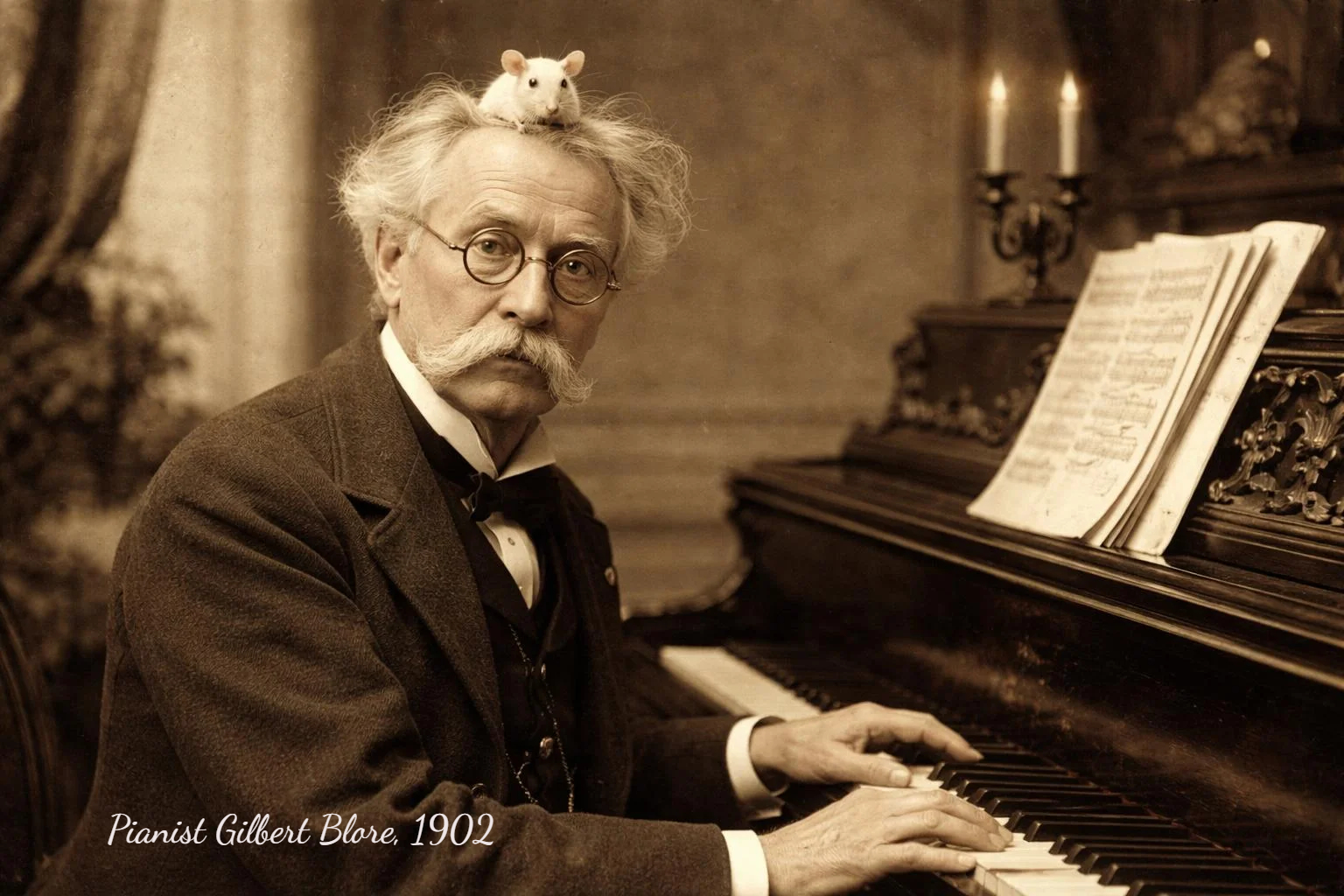
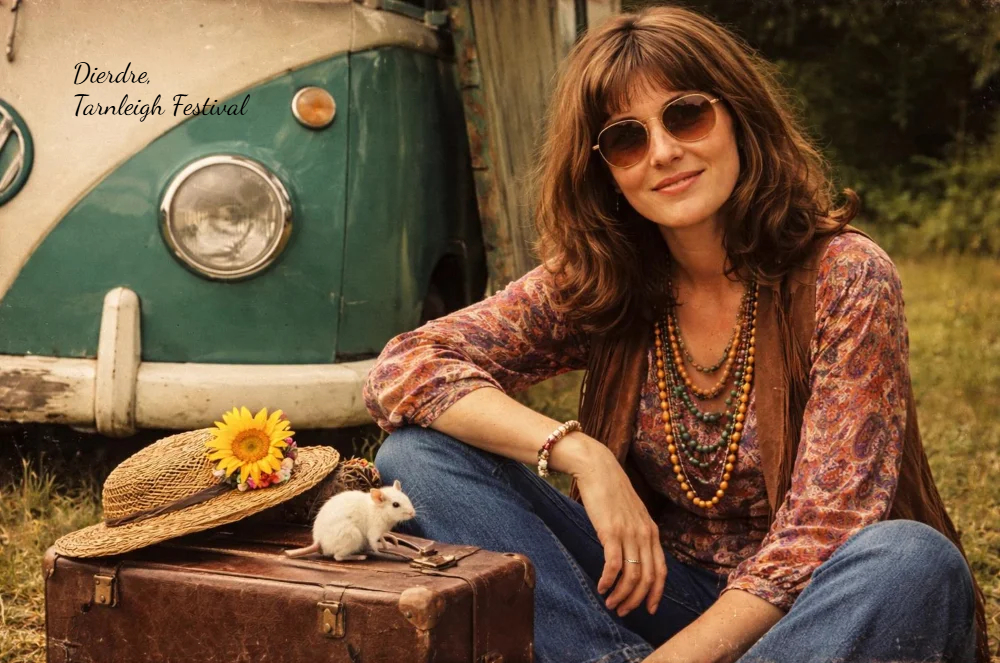
The novel wasn’t in the tin box in the shed. But I found a box of photos my mum gave me some time ago. Some of the photos are quite old. I think they’re worth keeping though. From what I’ve read in The Journal of Speculative Chronophysics, the invention of the time-machine isn’t that far away.
11:15 pm
I can’t sleep. Ruth phoned and was upset about something but she wouldn’t say what. I told her about finding the photos – many of which feature her. I said I was looking for that novel I once wrote. This made her laugh. “Don’t you remember. You rolled it up and put it in the big jug we brought at that French braderie. It’ll be in the cupboard under the stairs, right at the back I should think.” I asked her if everything was okay. She said I should finish the novel. “You were never the same after you put it in that bloody jug. What were you thinking?”
I had forgotten the novel was called, Will This Man Ever? Ruth remembered. It’s set in the 1960’s. The story takes place during a summer holiday in Cornwall. The protagonist, a young man fresh out of boyhood, sets off with his dad’s Eccles Alert caravan and his mum’s Ford Cortina in search of intimacy. He treats it like the holy grail. The novel is a series of letters he sends to his friend in Milton Keynes. It’s epistolary like the novel you’re reading. It has no real plot, except the plot of getting from one place to another with as little hassle as possible.
Monday, 10th February
Monday morning. I’ve had a mixed weekend. The What-Is-It Fair was interesting. A lot of sellers had driven up from the South of England and had brought with them an array of interesting items, stuff that you rarely see up here in the North. I had a fair bit of cash on me thanks to having found a purchaser for those bottles of nettle-sting wine I produced two years ago. Percy Preece lives in Mistlebrook and has always praised my wine making skills and has frequently told me that he’ll buy any excess stock I have.
Edwina was ecstatic all day long. As soon as we arrived at the fair, she informed me that she’d meet me “back in the car park” in three hours, not giving me any chance to negotiate an alternative time or place. She disappeared quickly into the crowd, almost dancing as she walked. I only bumped into her a few times. Once when she was eating a cream bun, once when she was talking to Dr Shadows and a last time when she had her foot stuck in a bucket. I didn’t stop to ask her how that happened. She did tell me on the way home but I won’t repeat it as it was quite uninteresting.
“Si vis amari, ama.” If you want to be loved, love.
– Ovid, Amores
So, what did I purchase with my nettle-sting money? Before I tell you, I just want to quickly celebrate the selling of the Mug You Can’t Throw Away. The purchaser signed the receipt to say that he was taking ownership of the accursed cup. I’m hoping this will be enough to keep it from reappearing back in my tea-cupboard.
And there’s some other good news. As I passed Edwina and Dr Shadows, I overheard them discussing the reopening of Plughole Seminary. I thought I must have misheard and checked with Edwina as we drove home. I had not misheard. The old academy reopened its doors to students last September. For the moment they only have two students but are hoping that with the March intake, the old lecture halls will begin to fill again.
I used to teach Applied Eschatology at the seminary. Part time, Tuesdays and Thursdays. I got the job following the completion of my PhD thesis: The Afterlife of Sacred Objects: Displacement, Deposition, and the Theology of Remains. Apart from my three former wives, my two children, this has been my greatest achievement. Here’s a quote from the thesis.
Anyway, and more importantly, they’re going to start some evening classes for the general public. Edwina wasn’t clear about when the classes would start. Most of them sounded remarkably uninteresting, except one. Dry Stone Walling within Fae Jurisdiction, (if Edwina got the name right), sounds like a course I could engage with. I will need to investigate this matter more.
My main purchase is being delivered this afternoon. I also bought a very old Swiss cuckoo clock, a pair of winter socks, seven jars of homemade lemon curd and a poem detector. I tasted a sample of the curd and it was absolutely delicious. “That’ll be nice on my homemade bread,” Edwina said on the way home. I had to agree. I think she expects me to go round in a few days’ time with a jar. “I’ll telephone you when I’ve done some baking,” she said, as I dropped her off.
Saturday was full of rain and heavy cloud with only a very brief moment of sunshine. I need to get out in the garden and do some pruning before spring lands and the sap begins to rise. Last year I forgot and had to suffer the sight of overgrown bushes all summer long. The bees were happy though. The bushier bushes led to an over-production of flowers. A lot more honey was made, I’m sure.
Sunday
The over-excitement of Saturday led to a quiet, contemplative Sunday. I took the car for a drive and ended up at the Derwent Reservoir – a rather beautiful lake a little bit beyond Blanchland. There were several large flocks of geese chanting like Buddhist monks, filling the natural calmness with a most wonderful and spiritual sound. The lake also attracts a good number of fishermen who were standing like reeds at the waterside looking out at their lines in perfect postures of deep meditation. I took my notebook and wrote a few thoughts down.
I love this place. Sometimes you just have to sit some-where that isn’t your usual where. A place that says things in different ways. Trees that have composed a different kind of music. A fence that disappears into lake water. Long, dead grass that’s waving its tall, thin fingers, composing poems in the air. Five sheep are grazing, they’re parked like ornaments on a grassy mantlepiece. Oh, to be in this February spirit, this hopeful spirit, looking forward to spring but not letting go of this driftwood afternoon in winter.
Rain. Quite heavy. What a miracle that everything fits so neatly together. Everything has its reason, its purpose. From the scribbling grass and musical trees, to the rain and my pen and the thoughts that flow through my ink onto the awaiting page.
Sunday night I read some of Ovid’s poetry and thought about love. After three wives I now find myself on my own. Did I do something wrong? The clock has managed to put up with me all these years. I can’t be blamed for its arthritis. I’ve put a jar of lemon curd aside for when Edwina phones. I love freshly-baked bread.
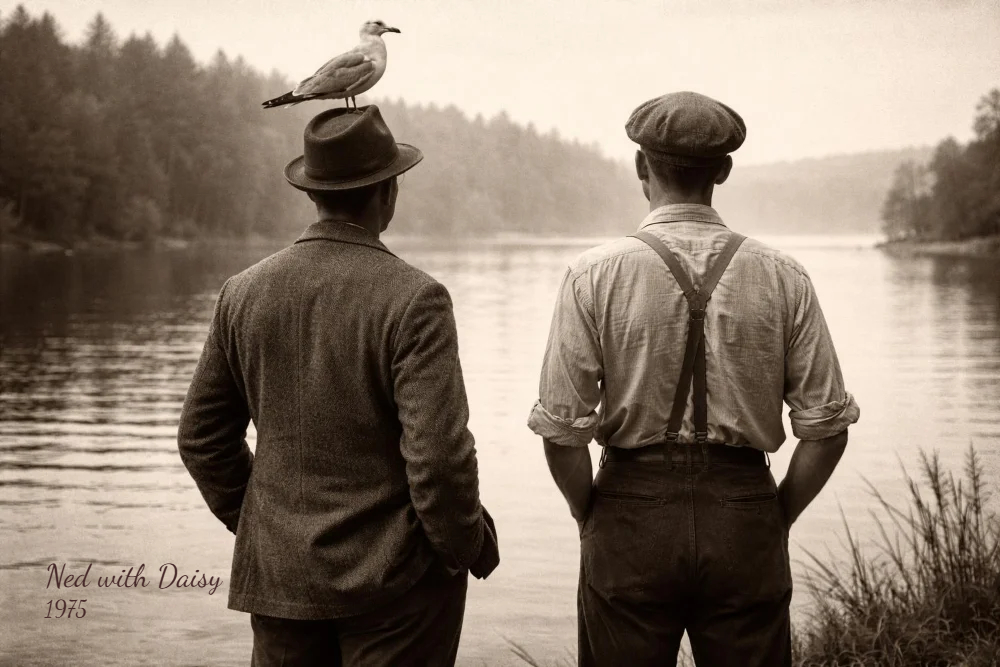
I loved my Uncle Ned. He used to drive a Morris Minor Traveller like the one Godfrey drives. Uncle Ned converted to Catholicism after hiking in the Austrian Tyrol. He fell asleep in a chapel and had a vision after being stung by a hornet. He used to say that Daisy, his seagull, was his guardian angel.
I will now go and paint the shop’s ceiling. I’m hoping to get the first coat finished before the delivery of my main purchase from the fair. I won’t tell you what it is yet. I’m excited but also very apprehensive. I’m not sure where I’m going to keep it. It has spent the last fifteen years in its present owner’s understairs cupboard. I wonder what Harriet will think of it?
Tuesday, 11th February
I had an interesting conversation with Godfrey today in the carpark of Holly’s Perishables. I asked him about his name. I asked if he found it uncomfortable when people called him ‘God.’ He laughed. “Names don’t belong to those they’re assigned to but to those who assign them,” he said. I told him that I had been given responsibility for this year’s living nativity. I explained that I have to find a venue, animals, a Jesus and a Mary and Joseph. He laughed again. “I dropped the Bible on my foot once. It was an original version kept in an olivewood box so it was very heavy. It broke my little toe and split the skin. There was blood everywhere. Words are dense. They’re also sad little things. Take the word daffodil. It has no daffodilness about it. It shouts but it’s not heard. The flower though, says nothing but everyone hears want it’s saying.” There was a moment of silence. “Stories belong to those who live them. The Bible only became mine after it broke my toe, despite the fact I’m mentioned in it quite a few times.” He winked and smiled. “I know of a cave not far from the Blackroot Mine. It’ll make a great stable. And there’s plenty of space around it for parking.” I helped him load his shopping into his car. As he was driving away he stopped and lowered his window. “Remember to be dust sometimes. A special kind of dust.”
Wednesday, 12th February
It’s my turn to choose this month’s book for the Tarnleigh Book Club – now hosted in the bookshop. I’m tempted to print out eleven copies of the draft of my old novel Will This Man Ever? There are no rules that stipulate it has to be a published work. It would be good to get feedback.
As my bric-à-brac shop is called: The Resurrectory, customers often beginning to me as The Rector. I’ve been sorting out some of the many books I have for sale. I will transfer them to the bookshop. I need to make room for eleven ceramic lamps, three framed mirrors, a carriage clock, and a collection of paperweights. These are all coming from Mr Bright the cowman at Bridge Farm.
I paid him £100 for the lot.
The quote below was taken from Dr Vane’s book: Logontology and the Threshold of Disclosure: Beckett and the Metaphysics of Waiting (1994). It’s one of five volumes of his work we have in the shop. For some reason I had annotated the page and circled the quote with a pencil.
Sandra, my assistant at the bric-à-brac shop, has started to call it The Waiting Room. She’s a kind of Godot groupie. She must have seen the play at least a hundred times. Unlike Vladimir and Estragon, the characters in my shop have no choice but to stay and wait for Godot – Godot being the customer who’s going to give them a second life.
On my way to the shop I saw Mrs Viola standing in front of the old Methodist church looking up at the For Sale sign. I think she might have been quietly crying. The church is where she was christened. It’s where she got married. It’s where her children took their first communion. It’s where she said goodbye to her husband.
Sandra had already opened the shop. She’s is very good with the shop’s congregation of objects. I’ve never found such sensitivity in anyone so young – she’s 23. I finished the ceiling yesterday. Only one item, a paper goldfish with a torn tail, was damaged. Sandra placed it in the ‘graveyard’ we have in the garden at the back of the shop.
I took delivery of my main What-Is-It Fair purchase on Monday afternoon. He arrived at my house in a large cardboard box. It took three people to carry him in. “Put him in the living-room,” I said. That was a mistake. He’d go better in the spare bedroom, but I can’t move him on my own, let alone carry him upstairs.
Monty Pegler was stuffed by Hargreaves & Daughter, Natural Preservationists, in 1859. Apparently they specialised in rare birds, foxes and domestic pets, and had an office in London, where Monty was killed by a runaway Hansom Cab. They agreed to turn their taxidermist skills to preserving Monty Pegler as payment of a large gambling debt accrued by Mr Hargreaves.
Monty came dressed in his favourite costume. These can be removed, washed, repaired and/or replaced – if necessary.
He was wearing:
- A black frock coat.
- A dark green waistcoat.
- A very white shirt.
- A grey silk cravat.
- Charcoal coloured wool trousers.
- Black leather shoes.
- A gold watch (chained to his waistcoat pocket).
The Victorian gent came with instructions and a large wooden box of paperwork. His last request was that the paperwork should ‘always be kept with me. For without them, I shall not be known.’
In the box there are:
- Ledger books.
- Notebooks.
- Letters.
- Bills and receipts.
- Calling cards.
- Investment papers.
- Insurance documents.
- His will.
Sandra said I was taking my love of abandoned objects too far when I introduced her to Monty. Harriet screamed and ran out of the house. Edwina cried and said she had seen him at the fair and had considered giving him a home but the price tag had put her off.